
Wonseok Bae, Ph.D.

Postdoctoral Scholar in Rare-Event Searches: Dark Matter, Neutrino, and Nuclear Physics

Northwestern University — Department of Physics & Astronomy

Wonseok Bae

Research

Neutrinoless double beta decay

Neutrinoless double beta decay

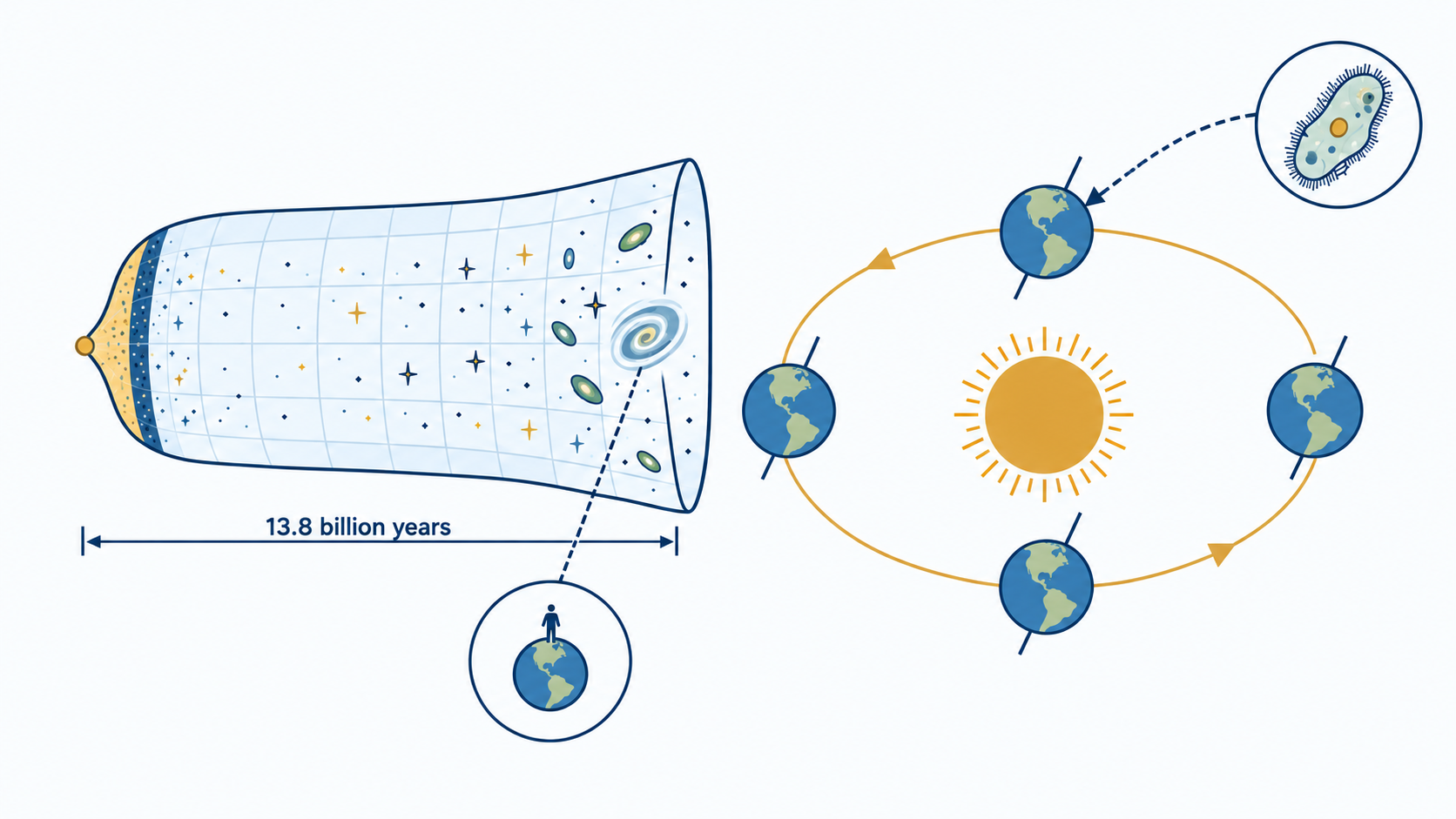
One of the deepest puzzles in physics is why the universe is dominated by matter, with almost no antimatter. Matter and antimatter should have been created in nearly equal amounts in the early universe and then annihilated almost completely — yet a tiny excess of matter, about one part in a billion, survived to form everything we see today (Figure 1). Leptogenesis offers an explanation: if neutrinos are Majorana particles — their own antiparticles — heavy Majorana neutrinos in the early universe could have decayed to generate a lepton asymmetry, which Standard-Model processes later converted into the matter–antimatter imbalance we observe. That same Majorana nature would reveal itself in a single rare nuclear decay.

Timeline of the universe from the Big Bang to today
Figure 1. The history of the universe. A tiny matter–antimatter asymmetry in the early universe left behind the matter that makes up everything we see today; leptogenesis, enabled by Majorana neutrinos, is a leading explanation for how that asymmetry arose.Image: NASA / WMAP Science Team. Not subject to copyright (NASA media usage guidelines); credit required.

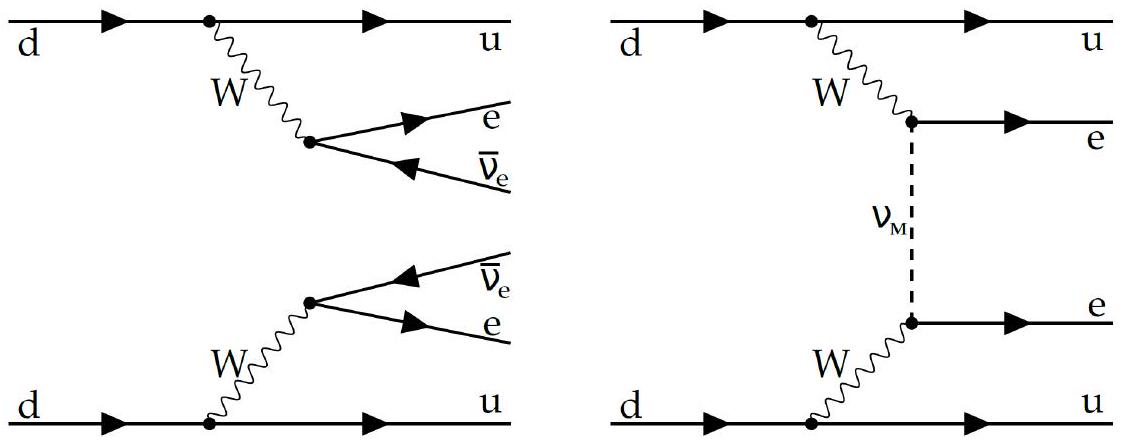
That decay is neutrinoless double beta decay. In some even–even nuclei, two neutrons convert into two protons at once, emitting two electrons. Every such double beta decay seen so far also releases two antineutrinos (2νββ) — a rare process still allowed by the Standard Model. If the neutrino is a Majorana particle, the same transition can happen with no neutrinos at all: neutrinoless double beta decay, 0νββ (Figure 2). It has never been observed.

Feynman diagrams of 2-neutrino and neutrinoless double beta decay
Figure 2. 2νββ (left) emits two antineutrinos; 0νββ (right) proceeds via light Majorana-neutrino exchange, with no neutrinos in the final state.

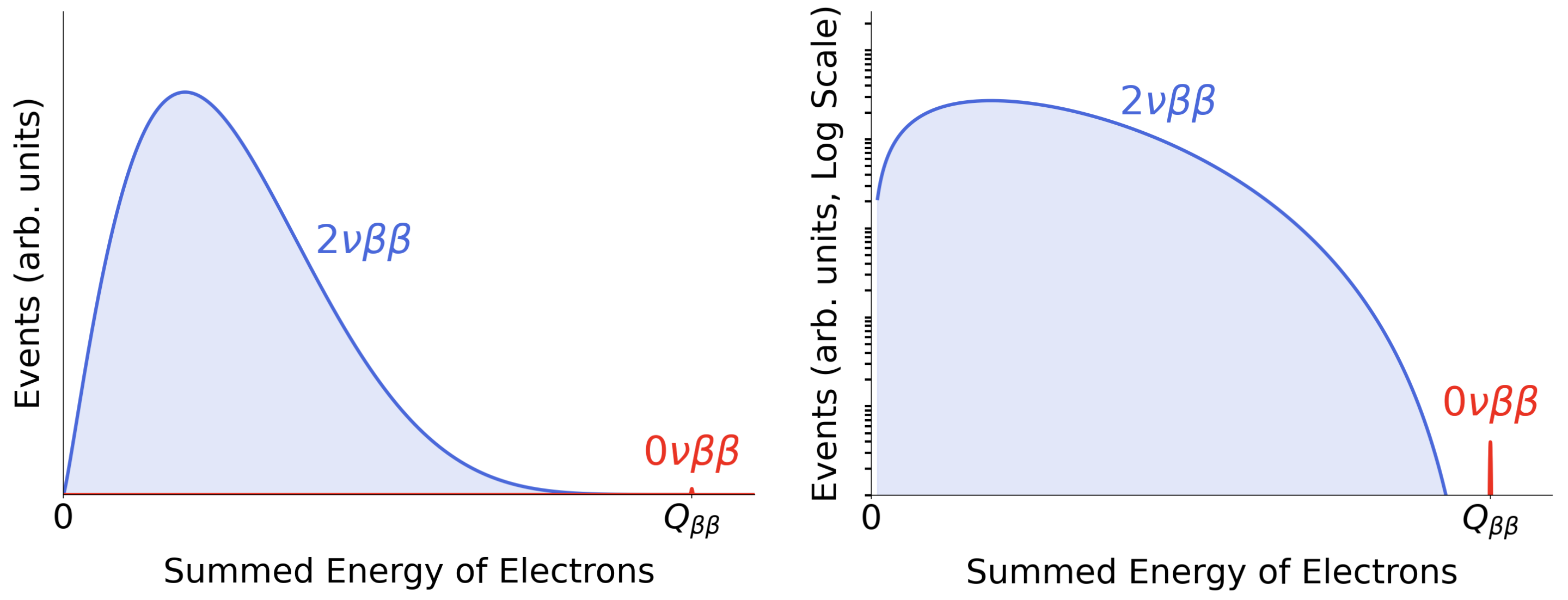
The two modes are told apart by the summed energy of the electrons (Figure 3): 2νββ gives a broad continuum, while 0νββ would appear as a single sharp line at the decay’s Q-value (Qββ ≈ 2039 keV for 76Ge). Detecting that line would prove lepton number is violated and bear on the matter–antimatter question above.

Summed electron energy spectrum: 2-neutrino continuum and 0-neutrino peak at Q-beta-beta
Figure 3. Summed electron energy: the 2νββ continuum versus the monoenergetic 0νββ peak at Qββ (linear, left; log, right). Not to scale.

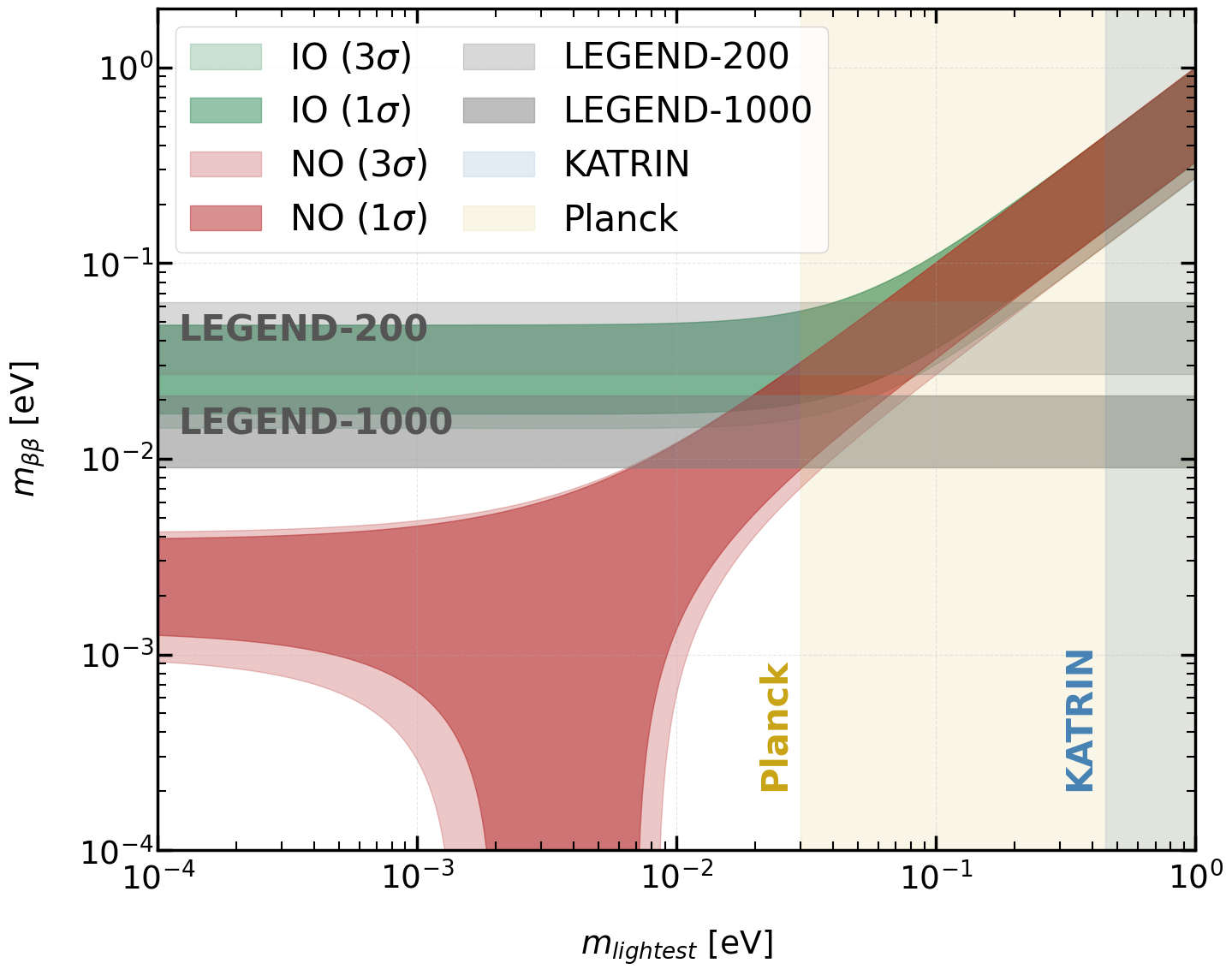
The measured half-life maps onto the effective Majorana mass mββ. As Figure 4 shows, today’s searches are pushing toward the band predicted for the inverted mass ordering; LEGEND-1000 aims to cover it and reach into the normal-ordering region.

Effective Majorana mass versus lightest neutrino mass with LEGEND sensitivity bands
Figure 4. Effective Majorana mass vs lightest neutrino mass. Green = inverted ordering, red = normal; gray bands show the LEGEND-200 and LEGEND-1000 reach (NuFIT 6.0; KATRIN and Planck exclusions shown).

Many isotopes and detector technologies have been applied to this search — in past experiments, in those running now, and in others planned for the future (Figure 5). 76Ge stands out: germanium detectors have the best energy resolution (~0.1% at Qββ), the crystal is both source and detector, and no known background makes a peak near Qββ.

Landscape of 0-neutrino-double-beta-decay experiments: background versus exposure
Figure 5. The 0νββ landscape — background vs exposure. Dashed lines mark discovery-sensitivity half-lives; LEGEND-1000 targets beyond 1028 yr.From M. Agostini, G. Benato, J. A. Detwiler, J. Menéndez and F. Vissani, arXiv:2202.01787 — Rev. Mod. Phys. 95, 025002 (2023). Licensed under CC BY 4.0.

The LEGEND experiment

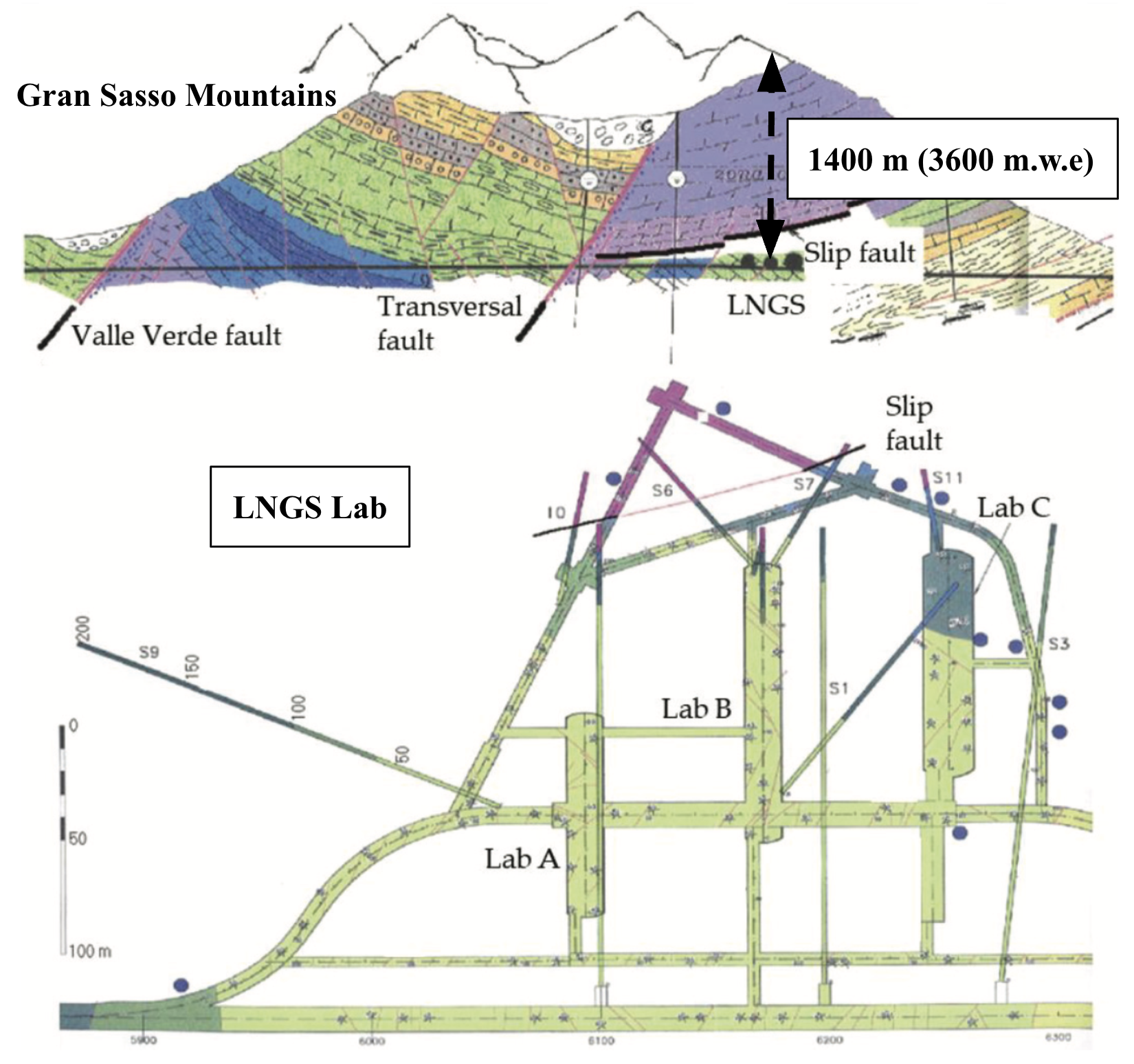
LEGEND — the Large Enriched Germanium Experiment for Neutrinoless ββ Decay — searches for 0νββ in 76Ge, building on the earlier GERDA and MAJORANA Demonstrator programs. It runs deep under the Gran Sasso mountains in central Italy (Figure 6), where about 3600 m of water-equivalent rock overhead shields it from cosmic rays.

Geological cross-section and hall layout of the LNGS underground laboratory beneath the Gran Sasso mountains
Figure 6. The LNGS underground laboratory beneath the Gran Sasso mountains: a geological cross-section (top) and the layout of the three experimental halls (bottom). LEGEND-200 is housed in Hall A; the future LEGEND-1000 will be sited in Hall C.Figure adapted from R. Guidotti & A. Castellani, “Tunnel Vaults under Seismic Excitation”, IntechOpen (2018), Fig. 3. Licensed under CC BY 3.0. LEGEND-200 and LEGEND-1000 labels added by the author.

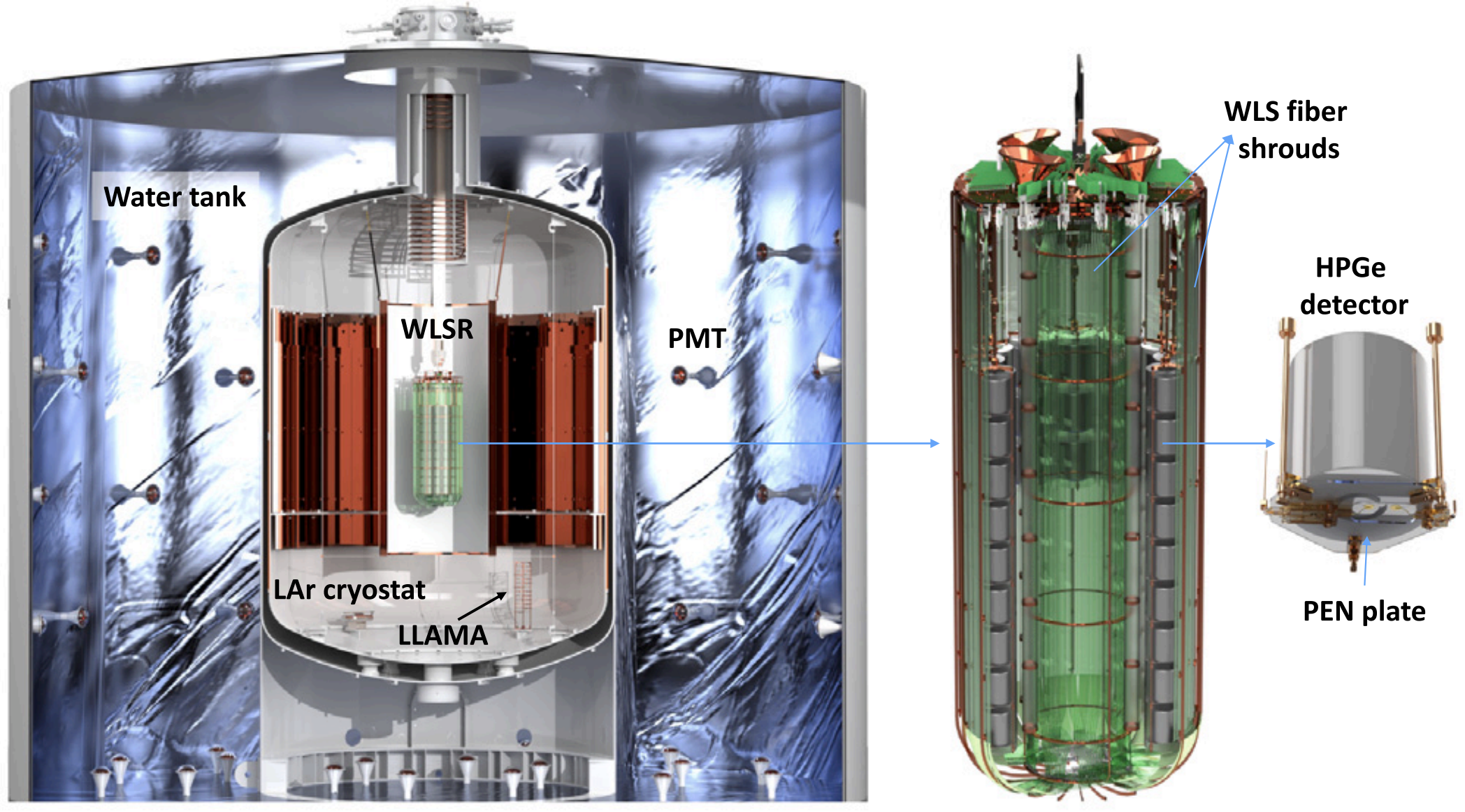
Germanium detector strings hang inside a liquid-argon cryostat that itself sits in a large water tank (Figure 7). Liquid argon acts as both a passive shield and an active veto: particles scattering in it produce 127 nm scintillation light — shifted by TPB and green WLS fibers and read out by SiPMs. Figure 7 also zooms into a single detector string, showing the WLS fiber shrouds and an HPGe detector on its support plate.

LEGEND-200 setup rendering and a zoomed view of an HPGe detector string with WLS fiber shrouds
Figure 7. Left: the LEGEND-200 setup, with the germanium strings and wavelength-shifting reflector (WLSR) inside the liquid-argon cryostat, surrounded by the water-tank PMT veto. Right: a detector string showing the WLS fiber shrouds and a single HPGe detector on its PEN support plate.From N. Burlac (on behalf of the LEGEND Collaboration), Nucl. Instrum. Methods A 1080, 170779 (2025). Licensed under CC BY 4.0.

LEGEND runs in two stages. LEGEND-200 (~200 kg of enriched 76Ge) has taken data since 2023 and targets half-lives near 1027 yr. Its first search, combined with GERDA and MAJORANA, set a limit of T1/2 > 1.9×1026 yr (90% C.L.), i.e. mββ < 75–200 meV. Background is beaten down by a layered veto — a muon veto, a multiplicity cut, pulse-shape discrimination, and the liquid-argon veto — whose effect on the spectrum is shown in Figures 8 and 9.

LEGEND-200 energy spectrum before and after veto cuts
Figure 8. LEGEND-200 spectrum (61 kg·yr): white = after muon + multiplicity cuts; red = after adding the LAr and PSD cuts. Inset zooms on Qββ.Reproduced from Fig. 1 of H. Acharya et al. (LEGEND Collaboration), “First Results on the Search for Lepton Number Violating Neutrinoless Double-β Decay with the LEGEND-200 Experiment,” Phys. Rev. Lett. 136, 022701 (2026), DOI: 10.1103/25tk-nctn; arXiv:2505.10440. Licensed under CC BY 4.0.
LEGEND-200 analysis window around Q-beta-beta
Figure 9. The Qββ analysis window; the dark line is the combined 76Ge limit with GERDA and MAJORANA.Adapted from Fig. 2 (top panel) of H. Acharya et al. (LEGEND Collaboration), “First Results on the Search for Lepton Number Violating Neutrinoless Double-β Decay with the LEGEND-200 Experiment,” Phys. Rev. Lett. 136, 022701 (2026), DOI: 10.1103/25tk-nctn; arXiv:2505.10440. Licensed under CC BY 4.0. Changes: cropped to top panel.

LEGEND-1000 scales up to ~1000 kg and aims beyond 1028 yr, which demands another order-of-magnitude cut in background (Figure 10). Key upgrades: underground-sourced argon (far less 42Ar), an internal neutron moderator, and new light-guide fibers. Figure 11 shows the projected background and signal near Qββ from a Monte Carlo simulation.

Conceptual design of LEGEND-1000
Figure 10. LEGEND-1000: germanium strings in underground-argon reentrant tubes, inside an argon cryostat with a neutron moderator, all within a water-Cherenkov veto.CAD rendering by P. Krause / LEGEND Collaboration, from the collaboration's internal wiki (legend-exp.atlassian.net/wiki), where the original is used in LEGEND-1000 design-overview documentation shared within the collaboration. Labels added by the author.
Projected LEGEND-1000 background spectrum near Q-beta-beta
Figure 11. Projected LEGEND-1000 background and signal near Qββ from a Monte Carlo simulation, showing a hypothetical 0νββ peak at T1/2 = 1028 yr.From LEGEND Collaboration, arXiv:2107.11462 — LEGEND-1000 Preconceptual Design Report (2021). Licensed under CC BY 4.0.

Direct dark-matter search · other rare event searches

Dark matter and WIMPs

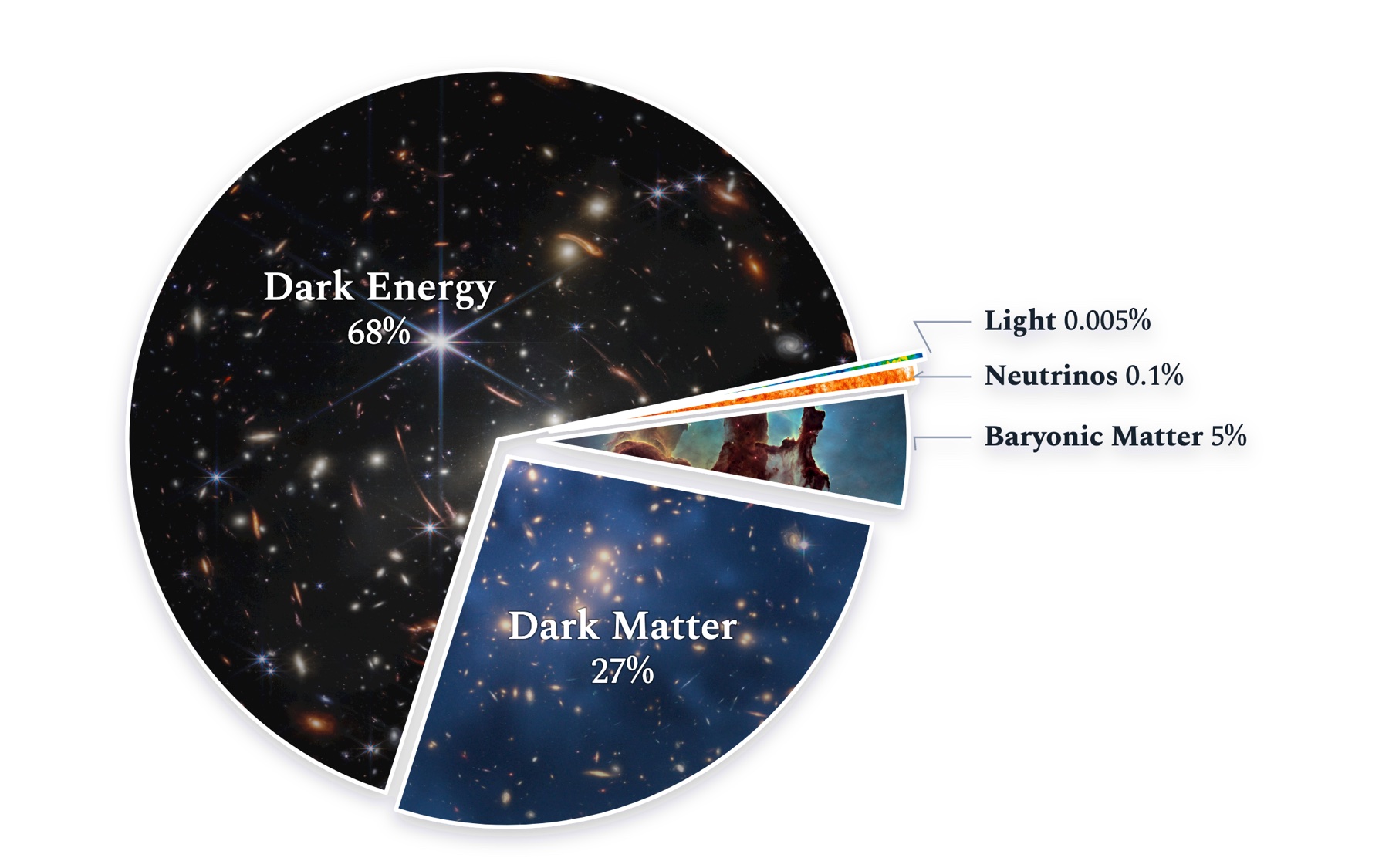
The universe contains far more mass than we can see. Its gravity shapes how galaxies rotate, binds clusters together, and molds the large-scale structure of the cosmos — yet it emits no light and has never been detected directly. This dark matter accounts for about a quarter of the total energy budget of the universe (Figure 1), and identifying it is one of the central goals of modern physics.

Pie chart of the energy budget of the universe
Figure 1. The energy budget of the universe: dark energy (Λ, 68%), dark matter (χ, 27%), and ordinary baryonic matter (B, 5%); neutrinos and photons make up the small remainder.From M. Cirelli, A. Strumia and J. Zupan, Dark Matter, arXiv:2406.01705 — SciPost Phys. Rev. 1 (2026). Licensed under CC BY 4.0.

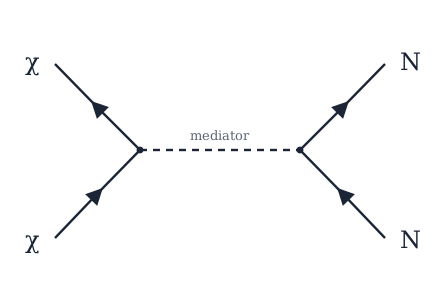
A leading candidate is the weakly interacting massive particle (WIMP) — a heavy, electrically neutral particle that barely couples to ordinary matter. If WIMPs exist, they should occasionally strike an atomic nucleus (Figure 2) and deposit a tiny amount of energy. Direct-detection experiments try to catch those rare recoils inside a shielded, ultra-quiet detector deep underground.

Feynman diagram of a WIMP scattering elastically off an atomic nucleus
Figure 2. A WIMP (χ) scatters elastically off an atomic nucleus (N) by exchanging a mediator, transferring a small recoil energy — the signal that direct-detection experiments try to catch.

The LZ experiment

LUX-ZEPLIN (LZ) is one of the world’s most sensitive WIMP searches. It runs about 1.5 km underground at the Sanford Underground Research Facility (SURF) in South Dakota (Figure 3), where the rock overhead shields it from cosmic rays.

Sanford Underground Research Facility location, deep underground in South Dakota
Figure 3. LZ operates about 1.5 km underground at the Sanford Underground Research Facility (SURF) in South Dakota.Illustration: Greg Stewart / SLAC National Accelerator Laboratory.

At its heart is a dual-phase xenon time projection chamber (TPC) holding seven tonnes of liquid xenon. When a particle scatters in the liquid it makes a prompt scintillation flash — the S1 signal. The ionization electrons it frees drift upward in an electric field into a thin gas layer, where they make a second, larger pulse — the S2 signal (Figure 4). Together, the S1–S2 delay gives the interaction’s depth, while the S1 and S2 light patterns give its horizontal position and energy; combining the S1 and S2 signals is what picks out the WIMP-like signal.

Dual-phase xenon TPC working principle: S1 and S2 signals
Figure 4. Dual-phase xenon TPC principle: a particle makes a prompt flash (S1); the freed electrons drift up and produce a second, larger flash (S2) in the gas.Adapted from LZ Collaboration, The Data Acquisition System of the LZ Dark Matter Detector: FADR, arXiv:2405.14732 — Nucl. Instrum. Meth. A 1068, 169712 (2024). Licensed under CC BY 4.0. Relabelled by the author.

Two arrays of photomultiplier tubes (PMTs) above and below the xenon collect this light (Figure 5, Figure 6). LZ wraps the TPC in nested vetoes: a xenon “skin” region that tags gamma rays, and an outer detector of gadolinium-loaded liquid scintillator that catches neutrons, and PMTs in the surrounding water tank that flag cosmic muons by their Cherenkov light.

Labeled schematic of the LZ detector
Figure 5. The LZ detector. A 7-tonne liquid-xenon TPC (1) sits at the centre of a water tank (2), viewed by top (3) and bottom (4) PMT arrays and held in a double-walled titanium cryostat (5). Gadolinium-loaded liquid scintillator (6) surrounds it, read out by its own PMTs (7) in the water; xenon-skin PMTs sit in the dome (8), and cabling leaves through the top (9) and bottom (10) conduits.From LZ Collaboration, The Data Acquisition System of the LZ Dark Matter Detector: FADR, arXiv:2405.14732 — Nucl. Instrum. Meth. A 1068, 169712 (2024). Licensed under CC BY 4.0.
The assembled LZ xenon detector The LZ top PMT array viewed from above
Figure 6. The assembled xenon detector (left) and its top PMT array viewed from above (right).Photos by Matthew Kapust, Sanford Underground Research Facility, used with permission. From D.S. Akerib et al., Nucl. Instrum. Methods A 953, 163047 (2020), Figs. 2–3.

With this layered design, LZ has set among the world’s strongest limits on WIMP dark matter across a wide mass range (Figure 7).

LZ exclusion limit on the spin-independent WIMP-nucleon cross-section versus WIMP mass
Figure 7. LZ’s limit on the spin-independent WIMP–nucleon cross-section (WS2022 + WS2024) — among the world’s strongest across a wide range of WIMP masses.Reproduced from Fig. 5 of J. Aalbers et al. (LZ Collaboration), “Dark Matter Search Results from 4.2 Tonne-Years of Exposure of the LUX-ZEPLIN (LZ) Experiment,” Phys. Rev. Lett. 135, 011802 (2025), DOI: 10.1103/4dyc-z8zf; arXiv:2410.17036. Licensed under CC BY 4.0.

Scintillator & wavelength-shifting materials

Detector material characterization

Scintillators and light-shifting materials are widely used in experimental particle and nuclear physics. Plastic scintillators form the trigger counters, hodoscopes, and calorimeter tiles of collider and fixed-target experiments, and the active planes of many neutrino and cosmic-ray detectors. Liquid scintillators instrument large neutrino observatories and fast-neutron spectrometers. Wavelength shifters convert hard-to-collect ultraviolet scintillation light into a detectable band in noble-liquid time projection chambers and calorimeters. Scintillating fibers build high-resolution tracking detectors and beam monitors. The same materials run throughout applied radiation detection as well — medical imaging, nuclear security, and space instrumentation.

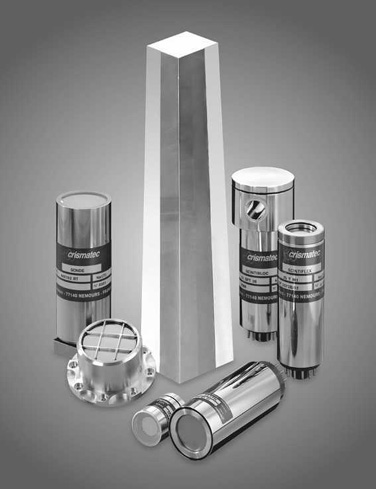
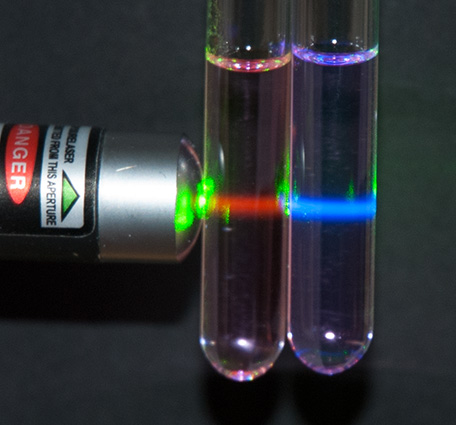
This research program characterizes such materials — plastic and liquid scintillators, wavelength shifters, and scintillating and wavelength-shifting fibers (Figure 1).

A scintillation crystal surrounded by packaged scintillation products Two vials showing Stokes and anti-Stokes emission under green laser excitation Scintillating glass optical fibres glowing under ultraviolet illumination
Figure 1. Representative optical materials in radiation detection: a scintillation crystal surrounded by packaged scintillation products (left), wavelength shifting in solution — Stokes emission in red and anti-Stokes emission in blue (centre), and scintillating glass optical fibres (right), where UV-induced fluorescence stands in for scintillation.Left: Scintillation crystal with packaged scintillation products by Saint-Gobain Crystals, via Wikimedia Commons, public domain. Centre: Stokes and anti-Stokes emission by Victor Gray, via Wikimedia Commons, CC BY-SA 4.0. Right: U.S. Department of Energy, via Wikimedia Commons, public domain. Cropped to a common aspect ratio.

The measurements span light yield, quenching factor, absorption and emission spectra, light attenuation length, pulse-shape-discrimination (PSD) capability, and how these vary with temperature and dopant concentration.

The aim is not a single material but a systematic, long-term survey: characterizing a broad library of candidates — hundreds of them over time — and reporting useful, reproducible benchmarks to the research community and to industry.

These benchmarks also benefit large rare-event search programs, whose veto detectors rely on well-understood light-collection materials. The characterization setup is compact — a light or radiation source, the material under test, and a DAQ system — and an excellent platform for training students across the full arc of an experiment, from hardware to analysis.

Case study: scintillating and wavelength-shifting fibers

Plastic scintillating and wavelength-shifting (WLS) fibers have been used since the 1980s — WLS fibers in MINOS, NOvA, GERDA, and LEGEND-200, scintillating fibers in DØ and the LHCb SciFi Tracker. Near ultra-low-background detectors, though, fiber choice is set by radiopurity as much as by optical performance, since radio-impurities in the fiber itself generate background radiation. Scintillating-wavelength-shifting (Sci-WLS) fibers, a recently developed class, are attractive because they add scintillation to wavelength shifting and light guiding — raising the possibility of self-tagging fiber-borne backgrounds in a veto, which is valuable for rare-event searches such as LEGEND-1000.

Two papers benchmark these fibers: their optical behaviour — emission and absorption spectra, attenuation length — in Bae et al., JINST 21, P01027 (2026), and their response to ionizing radiation, the signal that makes self-tagging possible, in Bae et al., JINST 21, P03053 (2026).

Publications

Selected publications

Full list on INSPIRE-HEP and Google Scholar.

  1. Response of wavelength-shifting and scintillating-wavelength-shifting fibers to ionizing radiationLead author W. Bae et al., Journal of Instrumentation 21 (2026) P03053.
  2. Optical characterization of wavelength-shifting and scintillating-wavelength-shifting fibersLead author W. Bae et al., Journal of Instrumentation 21 (2026) P01027.
  3. First results on the search for lepton-number-violating neutrinoless double beta decay with the LEGEND-200 experiment LEGEND Collaboration, Phys. Rev. Lett. 136 (2026) 022701.
  4. The Large Enriched Germanium Experiment for Neutrinoless ββ Decay: LEGEND-1000 preconceptual design report LEGEND Collaboration, arXiv:2107.11462 (2021).
  5. Interaction position, time, and energy resolution in organic scintillator bars with dual-ended readout M. Sweany et al. (incl. W. Bae), Nucl. Instrum. Methods Phys. Res. A 927 (2019) 451–462.

Talks

Selected presentations

Invited talks

LEGEND experiment and fiber studies Eljen Technology (scintillator manufacturer), Texas, USA · 2023, 2024, 2025
Fiber studies for next-generation 0νββ searches in the LEGEND experiment HEAP seminar, University of California, Los Angeles, USA · 2025

Conference talks

Fiber studies to improve the liquid-argon detector for LEGEND-1000 APS Meeting (USA) & KPS Meeting (South Korea), with Eljen Technology representatives · 2025
Fiber studies for the LEGEND experiment LEGEND collaboration meetings · 2023, 2024, 2025, 2026

Notes

Notes

Occasional writing and short videos on physics.

Nothing here yet — coming soon.